
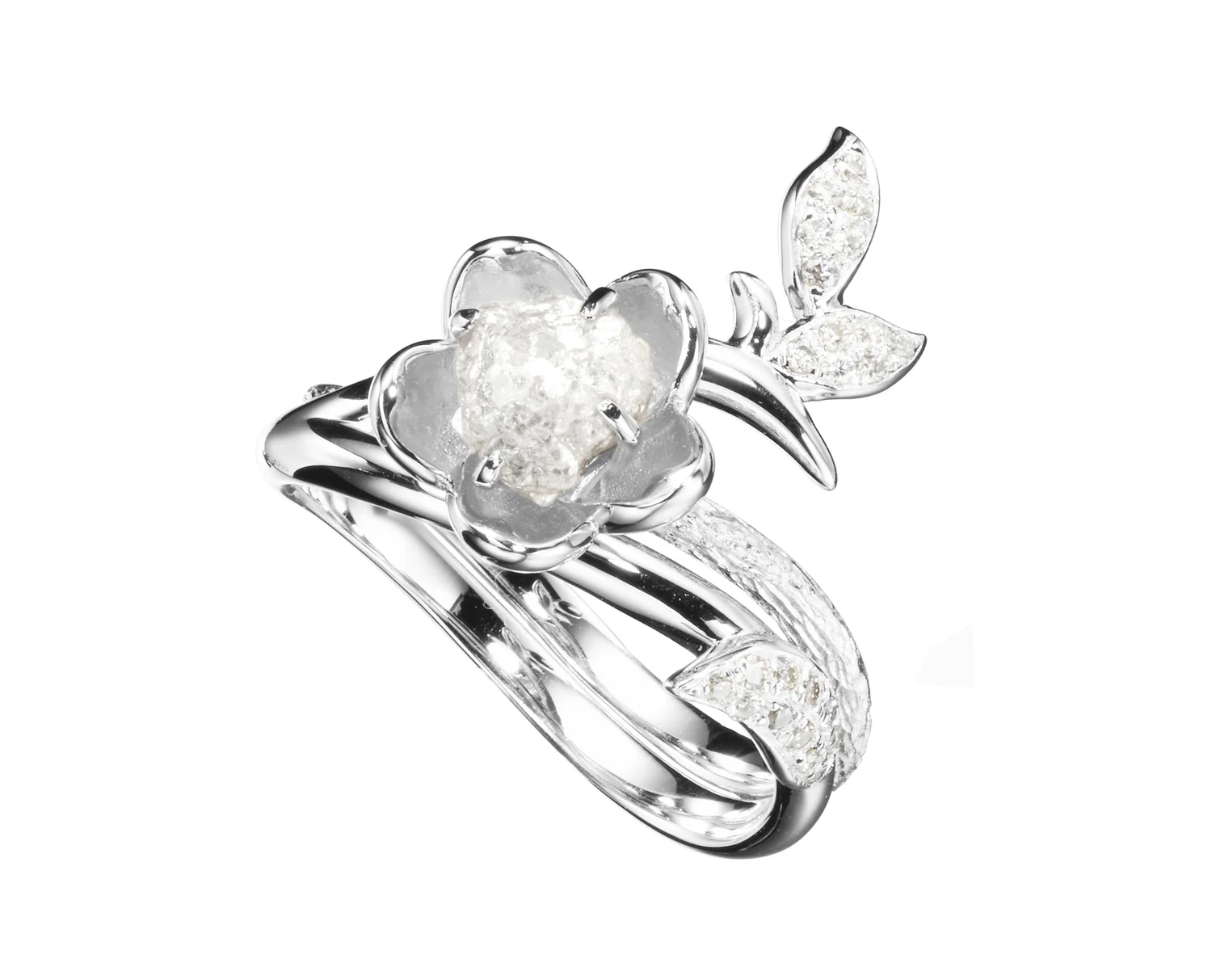
Ume starts on paper. The plum blossom is drawn freehand first — five petals, a small bud, a single stem — and only then does it move into CAD. We refuse to begin the technical work until the line drawing is one we would frame on a wall.
Once the line drawing is approved, the bloom is rebuilt in CAD as a five-petal relief. The CAD is the bridge between the hand and the gold — it lets us check clearances around the diamond, the depth of the bezel, and the way the ring will sit next to its fitted band. The ume set is built as one piece of geometry, not two: the band and the engagement ring share a shoulder line.
From CAD the file goes to lost-wax casting. Each ring is cast individually in solid 14k gold — never moulded, never plated. The sprue is cut, the surface is filed, and the petals are refined under the loupe until the bloom reads cleanly from across the room.
The diamond is set last. We do not set a stone we have not chosen — every raw diamond arrives in the studio with a photograph and a short video, and we set only after the owner has approved the actual stone they will receive. The setting is a heavy bezel with a fine milgrain edge, which protects the uncut stone and gives the ring its weight in the hand.
Each ring is finished, polished, and inspected by the same pair of hands that set the stone. The Ume set ships in an engraved wooden box, sized to hold both rings, with a small cloth pouch for the polishing cloth.